If this is your first visit, be sure to
check out the FAQ by clicking the
link above. You will have to register
before you can post: click the register link above to proceed. To start viewing messages,
select the forum that you want to visit from the selection below.
Welcome to the Shaolin Wahnam Institute Virtual Kwoon and Discussion Forum.
You are currently viewing our boards as a guest which gives you limited access to view most discussions and access our other features. By joining our free community you will have access to post topics, communicate privately with other members (PM), respond to polls, upload content and access many other special features. Registration is fast, simple and absolutely free.
When considering joining our community, please read our Forum Rules and FAQ. Please also note that this forum, although open to the public, is actually a virtual extension of the Shaolin Wahnam Kwoon (Martial Arts School). Upon "entering" the school, we do expect our guests and members to conduct themselves in an appropriate manner at all times.
If you have any problems with the registration process or your account login, please contact us.
Please follow this link to find out what a Virtual Kwoon is.
Announcement
Collapse
No announcement yet.
Choy-Li-Fatt and Kungfu Against Other Styles: 20 Questions for Grandmaster
Thank you Sifu! This answer, as well as the previous one, give a very good picture of the way that our kung fu has developed. This especially is a great modus operandi:
I spontaneously selected the best
Thank you Markus Siheng for taking the time to organize this thread.
The below answer contains Grandmaster Wong's views on the ongoing "Restoring the Glory of Kungfu" -topic. Highly recommended reading.
MMA athletes can be very formidable fighters
Question 2:
If a student shows interest in competing in MMA events, how much should their instructor encourage them? What benefits would there be from training for such a competition? What negatives would there be?
- Sifu Matt Fenton
Answer to Question 2:
"
The instructor should give the student full encouragement and help.
An important aim of our school is to restore the glory of kungfu. An important manifestation of this aim is to take part in free sparring competitions using kungfu skills and techniques, and win. We claim that our kungfu is capable of combat, and we must walk our talk.
But we are not going to let our students enter competitions blindly and be bashed. As scholar-warriors, we do not enter combat and then hope to win. We already have won, and enter combat to confirm victory.
We do so not out of vain-glory, but paradoxically out of humbleness. When we win we must not humiliate our opponents, as unfortunately some MMA artists do. We must give respect to our opponents due to them. This does not mean we may not hurt our opponents. If it is absolutely necessary, we will not hesitate to disable or even kill an opponent. Fortunately, unlike in real fights, it is not necessary in competitions.
There are many benefits derived from both the training and the actual participation of MMA and other free sparring competitions. There are, of course, also negatives. But as scholar-warriors, we shall make the negatives as opportunities for improvement.
An obvious benefit is to restore the glory of kungfu. We are true to our belief that our kungfu is combat effective, and are ready to prove it. We do not want to be made a mockery of our philosophy.
We also have no illusion that MMA artists and other free sparring competitors are formidable. Except for experienced fighters in our school, many of our students will be badly beaten if they enter free sparring competitions now. This is not because our kungfu is inadequate, but because they lack real fighting skills and experience, which are different from friendly sparring amongst schoolmates.
"
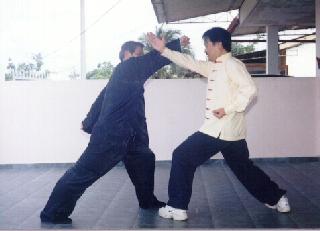
An old picture of Sigung Ho Fatt Nam's school's annual sparring competition.
The exponents use kungfu forms and techniques, not kickboxing.
Answer to question 2, part 2:
"
Thus, if our students enter sparring competitions now, not only they will be defeated but more significantly they will be injured, physically as well as emotionally. They will lose confidence in themselves as well as in our school, and have doubts as to what we claim is true.
But we shall change these negatives to opportunities for improvement. We shall train them systematically so that they will progress from a position of being defeated and injured to a position where they can win free sparring competitions honourably and without sustaining injuries themselves. Besides seeing this transformation and gaining a lot of confidence, they will also gain much in tactics and strategies, as well as developing internal force and mental clarity, which are not only useful in free sparring competitions but more important in their daily lives.
The Choy-Li-Fatt course and the Kungfu against Other Martial Arts course at the Winter Camp in January 2012 are excellent for this purpose. If all other things were equal, Choy-Li-Fatt is the most effective for free sparring competitions, with or without gloves.
The Kungfu against Other Martial Arts course provides the most effective fighting skills for handling other martial artists. It represents the crystallization of my more than 20 years of sparring and actual fighting experience.
Earlier I mentioned that our students should win free sparring competitions without sustaining injuries. Many people, including our students, may be very surprised at this statement. It is because they equate free sparring to generous exchanges of blows and kicks where injuries are inevitable. This is random hurting one another, not genuine self-defence. In genuine self-defence, we do not want to be hit, not even once. Such skills will be systematically taught at the Kungfu against Other Martial Arts course.
Even after taking these two courses at the Winter Camp, students should not enter free sparring competitions yet. They should apply their fighting skills in a 30-Opponent programme. This is a close-door secret in our school that students have to learn personally from their sifus.
After completing the 30-Opponent programme, students should still not enter MMA competitions yet. MMA competitions represent high-level fighting. Students should start modestly, taking part first in local, regional and national competitions to gain experience and confidence before entering MMA and international competitions. Even in relatively low-level competitions, we must be sure of winning before we enter the competitions. A scholar-warrior does not enter combat and hopes to win, he has already won and enter combat to confirm victory.
"
What kungfu techniques would be most effective
against the fast strikes of a skillful boxer?
Question 3:
Are some styles of Kung Fu more suited than others to fighting with Boxers? If so, which ones and why.
- Kevin, Shaolin Wahnam Ireland
Answer to Question 3:
" Yes, if all other things were equal, Choy-Li-Fatt is most suited than other styles to fighting with Boxers. It is because Choy-Li-Fatt techniques and footwork are excellent in overcoming Boxing techniques and bouncing about.
As most martial artists today fight like Boxers regardless of what styles they practice, Choy-Li-Fatt is an excellent choice if one wishes to be combat efficient. He must, of course, learn from a competent teacher. Unfortunately, most kungfu teachers today either only teach solo practice for demonstration or fighting like Boxers.
We shall have a better idea why Choy-Li-Fatt is more suited to fighting Boxers than other kungfu styles if we examine some examples of how different kungfu styles typically respond to Boxers’ attack and defence.
When a Boxer jabs, a typical response from a Shaolin practitioner is to ward off with a Single Tiger. Even before the Shaolin practitioner can make contact, the Boxer would have pulled back his first jab, and thrusts another jab. If the Shaolin practitioner attempts to ward off the second jab with a second Single Tiger, the Boxer would have thrown a right cross, followed by a rain of punches on the helpless Shaolin practitioners. The shifting from one False-Leg Stance to another, or from a False-Leg Stance to a Bow-arrow Stance by the Shaolin practitioner is also too slow for the bouncing of the Boxer.
On the other hand, the Shaolin practitioner using typical Shaolin strikes would have difficulty attacking a Boxer. If he attempts to strike a Boxer using “Black Tiger Steals Heart”, the Boxer would just parry away his punch with one hand, and hit his exposed head with the other hand. When the Shaolin practitioner tries to withdraw into a False-Leg Stance to avoid the Boxer’s strike, the Boxer would bounce in with a rain of hits on the Shaolin practitioner.
The scenario with a Taijiquan practitioner is similar. As a Boxer throws a jab, a Taijiquan practitioner would typically respond with warding off, using “Immortal Waves Sleeves”. The Boxer would withdraw his first jab, and throws a second jab, against which the Taijiquan practitioner would try to ward off with another “Immortal Waves Sleeves”. The Bower would follow up with a rain of hits on the helpless Taijiquan practitioner.
Similarly, using typical Taijiquan patterns, a Taijiquan practitioner would have difficulty attacking a Boxer. If the Taijiquan practitioner attacks with typical Taijiquan palm strikes and finger-thrusts, the Boxer would just parry them away, followed by crosses, hooks or undercuts, which a Taijiquan practitioner may not be accustomed to.
Indeed, these are the main reasons why many kungfu practitioners could not match Boxers, and also why they discard their kungfu techniques and fight like Boxers.
Does this mean that kungfu is no match for Boxing? Unfortunately, the answer is yes – for most kungfu practitioners today. Otherwise they would not perform kungfu only in solo demonstration, but discard it when sparring and adopt Boxing techniques.
But for those who have a wide understanding of kungfu philosophy, skills and techniques, the answer is no. They will choose those skills and techniques that are most suited to overcome Boxers. This is what we are going to do at the “Kungfu against Other Styles” course during the 2012 Winter Camp.
The big problem for most kungfu practitioners is that there are so many skills and techniques to choose from, and they do not know what to choose. In fact many of them do not even know the difference between skills and techniques. The problem is further aggravated by the fact that typical kungfu patterns which they normally practice are not suited to fighting Boxers.
Choy Li Fatt (Choy Lee Fut) against boxing
The situation with Choy-Li-Fatt is different. Typical Choy-Li-Fatt patterns are suited to fighting Boxers and other martial artists! This means that Choy-Li-Fatt practitioners do not need to choose from hundreds of techniques those techniques that are most suitable; they just use their typical techniques!
But they still need combat skills and need how to use the techniques for combat. If they don’t, if they only perform the techniques for solo demonstration, they will still be bashed by Boxers and other martial artists. Acquiring the skills and learning how to apply the techniques for combat are what we shall do at the Choy-Li-Fatt course during the 2012 Winter Camp in Norway.
Meanwhile, let us examine how a Choy-Li-Fatt practitioner would typically respond to a Boxer’s attack. Please bear in mind that while knowing the philosophy (as explained below) is the first important step, one must practice and practice to be able to apply the response effectively.
Instead of warding off a Boxer’s jabs as in Shaolin Kungfu and Taijiquan, a Choy-Li-Fatt practitioner would strike his arm against the Boxer’s jabbing arms. Would the Choy-Li-Fatt practitioner be hit by the Boxer’s jabs if he does not defend against the jabs? No, he won’t; his body-movement and footwork would have avoided the Boxer’s jabs while he simultaneously strike the Boxer’s arms.
If the Boxer attempts to move forward to rain blows on the Choy-Li-Fatt practitioner, the Choy-Li-Fatt practitioner would retreat a step and simultaneously rain blows on the Boxer’s arms or body. If the Boxer tries to bounce away, the Choy-Li-Fatt practitioner would move in swiftly to rain blows on him.
The interesting point is that the same technique can be used for attack or defence. Indeed, the attack and defence run together harmoniously.
The two arms of the Choy-Li-Fatt practitioner are like two iron rods. If an opponent attacks, he uses his rods to strike the attacking arms. If the opponent retreats, he uses his rods to strike the opponent’s arms or body.
"
The following answer includes a comprehensive description on what you'll learn at the Choy-Li-Fatt -course.
I don't know about you, but I'm stoked!
A Choy-Li-Fatt (Choy Lee Fut) practitioner often uses his arms like iron rods.
This requires a good foundation of force training.
Question 8:
Sifu what specifically does one stand to attain from the Choy-Li-Fatt course, besides the obvious multi-opponent combat advantage and the opportunity to learn the form from an internal perspective. This is in relation to other styles already ingrained in Shaolin Wahnam.
- Sean
Answer to Question 8:
"
In relation to other styles and courses already taught in Shaolin Wahnam, the following are specific benefits one can attain from the Choy-Li-Fatt course at the 2012 Winter Camp in Norway.
1. Training with dumb-bells.
One remarkable improvement I had when I learned from Sifu Ho fatt Nam after I had leant from Uncle Righteousness was a tremendous increase of force. I felt I was not very forceful in my kungfu performance, so during a chit-chat I asked my sifu, Sifu Ho Fatt Nam, how I could increase my force.
He told me to practice Thirty Punches with stone-locks. He did not have to show me how to do it as he had earlier taught me Thirty Punches (with empty fists), but he explained how to make stone-locks using cement, iron bars or strong cane.
It was amazing. After practicing Thirty Punches with stone-locks for only a few months, my force increased so dramatically that when I performed a kungfu set I caused “khuen foong”, literally “fist-wind”, or audible vibrations in the air. I was very happy as it was described in kungfu stories that only high-level masters could cause “fist-wind”.
Stone-locks are quite clumsy. In the Choy-Li-Fatt course we shall use more elegant dumb-bells, which I believe can even produce better results. It will be the first time in Shaolin Wahnam history that I teach using dumb-bells to increase force.
2. Internal Approach to External Method
Practicing with dumb-bells to increase force is an external method. We in Shaolin Wahnam are very special. After teaching students the external method so that they can have some experience of it, I shall teach them how to practice the same method in an internal way using chi flow. The students will then have a comparison between the external and the internal approach of the same method. They will also be amazed at the result.
3. Technique of Whirl-Wind Fists and its Counters
Imagine you are holding two iron rods and swinging them methodologically on an opponent. If he attacks you, you hit their attacking arms with your iron rods. If they retreat, you swing your iron rods on his head or body. Now you use your arms like two iron rods, which is actually more versatile. This is a famous technique in kungfu but is little understood because it requires some subtle movements to make it effective. It is known as “foong chei khuen fatt” or the “technique of whirlwind fists”, and is very formidable if you arms are powerful and you know the subtle movements which will be taught at the course.
Now suppose your opponent uses “whirlwind fists” on you. How would you defend yourself? Many people would be at a loss facing two powerful swinging rods. Students at the Choy-Li-Fatt course will learn effective counters against these “whirlwind fists”.
4. Finer Points of Choy-Li-Fatt
Choy-Li-Fatt is a very formidable art against most opponents, but there are some innate weaknesses, and a high-level master could exploit these weaknesses. However, not many people know these innate weaknesses, and less know how to exploit them. (When you realize how many free offers people hand out in free sparring today, and how seldom their opponents take up these free offers, you would not be surprised at the above fact.)
At the course students will learn about these innate weaknesses, and how to exploit them. Does this mean the end for Choy-Li-Fatt practitioners? No, if they also know what the innate weaknesses are, and how to respond when opponents exploit them. This is what Jeffrey Segal called the chess aspect of kungfu. The Choy-Li-Fatt course is going to be very interesting.
"
Even without internal methods, a karate exponent can build some internal force
from routinely punching into air. Do you know why?
Question 9:
How does a Choy Li Fatt master's external force become internal? Is it therefore possible for modern external martial artists (i.e Boxers, kickboxers) to develop internal force at some stage?
- Ish
Answer to Question 9:
" When a master practices an external force training method long enough, the force will naturally become internal, though the method remains external.
For example, punching a sand-bag is an external method. It will develop muscular strength. But if you continuously punch a sand-bag over a long period of time, when your knuckles have develop callous to prevent you feeling any pain on contact, and your muscular strength sends the sand-bag flying away readily, the repeated movements of your arms will generate energy flow that develops into internal force.
Actually, although the techniques may be different, the principles in internal force training are similar. The difference is that internal practitioners do not have an obstacle (like a sand-bag) to block their physical movements, and do not tense their muscles to block their energy flow in repeated actions.
I remember years ago I read about Karate masters saying that students could develop more force punching into the air than onto a sand-bag. I guessed the Karate masters did not know the underlying reasons, though I knew they were correct.
I also did not know the reasons then. It was only years later that I discovered the secret while teaching chi kung. And I applied the secret successfully to kungfu teaching, with the result that our students could develop internal force in days when it normally took other people months or years.
Yes, external martial artists, like Boxers and Kick-Boxers, can develop internal force if they practice their external methods for a long time. In fact some advanced external martial artists have internal force in this way, though they may not realize it. A tell-tale sign is that these advanced external martial artists are relaxed. If they tense their muscles, they will block their chi flow and negate their internal force."
…and we're back to the "Kungfu Against Other Styles" -Q&A. Enjoy!
.
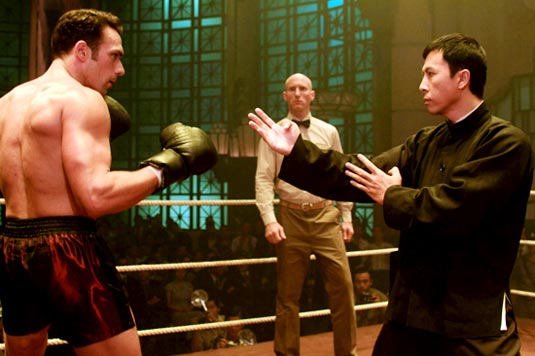
A scene with the boxer Twister fighting against Ip Man, portrayed by
Darren Shahlavi and Donnie Yen respectively, in Wilson Yip's film "Ip Man 2"
Question 4:
In the film “Ip Man 2” a fight between a boxer named Twister and Ip Man is a very closely contested affair. Did the film makers portray a plausible scenario? By this I mean, could the combat efficiency of a skilled boxer nearly equal that of a very highly skilled Wing Choon Kung Fu master such as Ip Man?
- Kevin, Shaolin Wahnam Ireland
Answer to Question 4:
"
My opinion is that the scenario portrayed in the film was not plausible. In the film Ip Man successfully fought through an ambush of many armed assailants out to take his life. Not only he saved himself, he also saved his student who was far less skillful. With this level of skills, Ip Man in the film could easily beat the boxer.
There is no doubt that a top boxer is very formidable fighter fighting within his Boxing rules. However, if there are no rules as in a real fight, a skilled boxer would be no match against a highly skilled Wing Choon master or a master of any kungfu style.
Even if Boxing rules were followed, which would place kungfu masters in a huge handicap, they could beat skilled Boxers readily. Indeed, this actually happened in China in the early 1900s when kungfu masters like Huo Yun Jia and Wang Zi Ping convincingly beat foreign Boxers by a huge margin.
There simply is a huge gap in combat potentials between kungfu, which is a life-death fighting art, and Boxing, which is a sport protected by many safety rules. A boxer’s techniques are severely limited only to strikes to the body and parrying with the hands, whereas a kungfu practitioner has a range of techniques that boxers may not even imagine to be possible.
Even if a kungfu practitioner has to put on gloves and follow Boxing rules, he still has a bigger range of attack and defence techniques than a boxer by a huge margin. Hence, it is a blantant excuse to the initiated when some kungfu practitioners say that they could not fight if they put on gloves.
The fact is that even without the boxing gloves these kungfu practitioners could not fight because their training is only on solo demonstration and never on combat. If they have had kungfu combat training, they would be able to fight even when putting on boxing gloves would have much reduced their fighting potential.
Choy-Li-Fatt Kungfu is particularly effective in this respect. If all other factors were equal, a Choy-Li-Fatt practitioner would be more combat efficient than practitioners of all other martial arts – with or without gloves. This is because of the wide range of Choy-Li-Fatt techniques for boxing-style fighting.
In other words, if both combatants have equal force, speed and fighting experience, the one using Choy-Li-Fatt techniques would have a bigger advantage in winning than the other using any other martial art! If the Choy-Li-Fatt practitioner loses the combat, it is not because of his techniques or boxing gloves he has to wear, but because of his speed, force, fighting experience or other factors.
One of the main objectives of the Choy-Li-Fatt course in the Winter Camp of January 2012 is to realize this special feature of Choy-Li-Fatt in combat – with or without gloves, and with or without abiding by Boxing rules.
"
The material is so rich, the Master so skillful and generous.
With all the arts of Bodhidharma and Choy Li Fatt and Kung Fu against other styles put together, if you practice our arts and you live in Europe, you simply must accept this great gift.
"Then how could chi kung overcome diseases where the cause is unknown or when there is no cure? The question is actually incorrect. The expressions "the cause is unknown" and "there is no cure" are applicable only in the Western medical paradigm. The expressions no longer hold true in the chi kung paradigm. In the chi kung paradigm the cause is known, and there is a cure."
Here's another installment of "Kungfu Against Other Styles" ... read on!
In China, "kungfu" is a word known in every house
Question 5:
What are the most crucial elements that distinguish Chinese kungfu from all other fighting arts?
- Sifu Zhang Wuji
Answer to Question 5:
" If I am to pick the most crucial element that distinguishes Chinese kungfu from most other fighting arts, I would choose internal force. It separates Chinese kungfu from all other martial arts.
Because Chinese kungfu focuses on internal force, whereas other martial arts don’t, it results in many manifestations. For example, due to internal force, age, gender and size are not crucial in Chinese kungfu, but this is not the case in other martial arts. An elderly, fragile-looking lady can be more powerful and more combat efficient than a young, muscular man, whereas in other martial arts an older person is normally stronger than a younger person, a man normally stronger than a woman, and one with big muscles normally stronger than one who is smaller sized.
Because of internal force, Chinese kungfu training contributes to health, vitality and longevity, whereas other martial arts do not! This may come as a surprise to many people, and some may be angry at the statement, but it is to their benefit to know the truth.
The truth is that other martial arts may contribute to the practitioners’ combat efficiency and physical fitness, but not to their health, vitality and longevity. This does not mean that those who practice other martial arts cannot be healthy, have vitality and enjoy longevity. They can, but it is due to other reasons, and not due to their martial art training. On the other hand, even leaving aside other reasons, just by practicing Chinese kungfu alone contributes to the practitioners’ health, vitality and longevity.
Why is this so? It is because of internal force training in Chinese kungfu, which involves energy flow, whereas in other martial arts the training is physical which involves muscular tension and metal stress.
In other martial arts, energy is spent during training, resulting in practitioners having less energy after the training than before. As good health, vitality and longevity depends on the amount and smoothness of energy flow, a reduction of energy due to physical training detracts from good health, vitality and longevity. On the other hand, in kungfu training, energy flow is generated, resulting in practitioners having an increase in both volume and smoothness of energy flow after the training than before. This contributes to good health, vitality and longevity.
In internal force training, practitioners need to be physically and mentally relaxed. This further enhances their energy flow, resulting in better health, vitality and longevity. In other martial art training, which is physical, practitioners tense their muscles so as to generate physical strength, which also results in mental stress. This causes energy blockage which further distract from health, vitality and longevity.
Internal force training is actually found in all styles of kungfu, though it is not obvious in so-called external styles! It is taught right at the start of all kungfu styles – in the form of stance training. It lays the foundation of kungfu, which is not just strengthening practitioners’ legs as many students erroneously believe, but a training of energy and mind.
In their practice, kungfu practitioners of all styles are to be physically and mentally relaxed. It is only when they are relaxed, can they explode internal force, or “fatt keng” in Cantonese, “fa jin” in Mandrin pronunciation. I remember that when I was small I heard and read stories of masters of so-called external styles, like Wing Choon and Prahying Mantis, exploding internal force when fighting. Leong Chan, a famous Wing Choon master who was slender and elegant, for example, could fell an able-bodied opponent with just a single palm strike.
However, genuine kungfu with internal force training is now very rare. Many kungfu students today not only bounce about like Boxers but also adopt physical training of other martial arts like weight lifting and rope skipping. It is like throwing away gems for stones.
"
A very enlightening installment! I heard about "internal training" at the highest levels of Kaze Arashi Ryu aiki jujutsu (A Japanese "mountain monk" fighting style) and Shotokan Karate when I was training in those styles many years ago. All of my sensei, however, still did running, weight-lifting, and other forms of physical conditioning to improve their stamina and strength.
This just goes to show how incredible and mind-boggingly generous Sigung and the sifus of Shaolin Wahnam are in introducing even beginners and those who do not regularly train in Shaolin Wahnam kwoons (like me!) to force, energy, and mind training.
I like making silly videos (including kung fu ones!) every so often on YouTube and taking pictures of weird things on Instagram.
Sigung Ho Fatt Nam, who provided for his family as a
professional prize fighter in his younger days, was a terrific kungfu fighter
Question 6:
Would Shaolin masters of the past like Uncle Righteousness , Grandmaster Ho Fatt Nam , The Ten Tigers of Canton , Pak Mei , and Bodhidharma compare to masters in the modern day when it comes to combat efficiency and internal force.
- Steve Rivera, Shaolin Wahnam USA
Answer to Question 6:
" Modern day masters are nowhere in combat efficiency compared to masters in the past not only in Shaolin but also in any kungfu styles. Past masters could kill with just one strike, whereas modern day masters freely exchange blows in combat.
Past masters could walk down a street and be ambushed by more than 30 armed assailants yet emerged unhurt. As recent as 60 years ago, my sifu, Sifu Ho Fatt Nam, single-handedly fought off more than 30 armed assailants who intended to kill his family and burn his house, and of course he and his family remained unhurt. Today many modern day kungfu masters cannot even fight against a good Boxer or a Karate blackbelt.
"
- Grandmaster Wong Kiew Kit
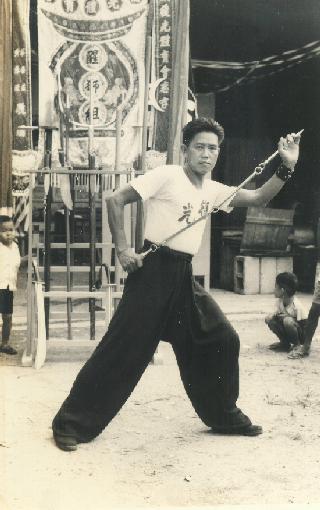
Sigung Lai Chin Wah was renowned for both his combat ability
as well as his righteousness
We process personal data about users of our site, through the use of cookies and other technologies, to deliver our services, personalize advertising, and to analyze site activity. We may share certain information about our users with our advertising and analytics partners. For additional details, refer to our Privacy Policy.
By clicking "I AGREE" below, you agree to our Privacy Policy and our personal data processing and cookie practices as described therein. You also acknowledge that this forum may be hosted outside your country and you consent to the collection, storage, and processing of your data in the country where this forum is hosted.
 Tweet
Tweet





Comment