If this is your first visit, be sure to
check out the FAQ by clicking the
link above. You will have to register
before you can post: click the register link above to proceed. To start viewing messages,
select the forum that you want to visit from the selection below.
Welcome to the Shaolin Wahnam Institute Virtual Kwoon and Discussion Forum.
You are currently viewing our boards as a guest which gives you limited access to view most discussions and access our other features. By joining our free community you will have access to post topics, communicate privately with other members (PM), respond to polls, upload content and access many other special features. Registration is fast, simple and absolutely free.
When considering joining our community, please read our Forum Rules and FAQ. Please also note that this forum, although open to the public, is actually a virtual extension of the Shaolin Wahnam Kwoon (Martial Arts School). Upon "entering" the school, we do expect our guests and members to conduct themselves in an appropriate manner at all times.
If you have any problems with the registration process or your account login, please contact us.
Please follow this link to find out what a Virtual Kwoon is.
Thank you WongYing for your post and your comments on the first sequence shown...
...I had hoped that some of our Wahnam students would have made some comments.
I shall wait until tomorrow, to give them a chance before giving more information on the 2 questions I asked, and the link to the first application of Press-Strike demonstrated by Sifu.
Until then ...
Marcus
Namo Amitabha Buddha Namo Amitabha Buddha Namo Amitabha Buddha
Eventhough I am not a very good practitioner of Kung Fu and I don't know almost anything of Eagle Claw except that it uses a lot chin na techniques I will try to comment as good as I can to the questions of Sifu:
1.What similarities can you see between the patterns of this Eagle Claw first combat sequence and the style of kungfu we practice in Shaolin Wahnam.
a)There are stances (6-4 and bow-arrow) and transition steps between them.
b)There are poise patterns, using the 6-4 stance with both the hands in fists, just like the simple poise patterns in Shaolin Wahnam Lohan asks the way/Single tiger. It reminds me also a litle bit of the poise pattern in Wahnam Tai Chi Chuan (Play the flute?).
c)Just like the Tan Tui sequences has both left and right leg modes and Sigung executes the patterns 3 times in one side. Tan Tui isn't the usual style in Shaolin Wahnam but I just liked the similarity
d)It incorporates 1 defense for low-middle-high attacks and 2 kind attacks (front hand - back hand, just Black tiger) low-middle-high (this I believe depends of the situation). So someone can learn the basic appropriate hand attacks and defenses with just one sequence.
2.Why is this first sequence important in Eagle Claw Kung Fu?
Its name it gives the clue, Pressing attack. I think that someone with the right skill can press his/her opponent to the wall using this sequence only (doing the appropriate changes of course). This reminds me again the Tan Tui sequences (because there are the both of them North styles?) From the other hand someone using only the Black Tiger - Single Tiger (1st Shaolin Wahnam Sequence) can press also his/her opponent in the wall
That's all I could find. I am open to corrections and I look forward for the right answers
Nice try and I can certainly see where you are coming from. I'll leave you guessing just a few hours longer to see if anyone else wants a try and then I'll give you my answer later this evening.
I just wanted to say that the video for the first combat application of Press-Strike is available for viewing: Opponent attacks on Left.
Well, I'm surprised that none of our Dragon specialists answered question 1:
What similarities can you see between the patterns of this Eagle Claw first combat sequence and the style of kungfu we practice in Shaolin Wahnam.
Surprised because the patterns are found in your Dragon Form Set.
Question 2: Why is this first sequence important in Eagle Claw Kung Fu?
Answer: I recall Sifu talking during the Cross Roads At Four Gates course at last years Summer Camp. He spent a lot of time discussing and demonstrating the 'signature' pattern/s of Uncle Righteousness, Sigung Ho Fatt Nam, Sigung Chee Kim Thong, Sigung Choe Hoong Choy and Wong Fei Hung.
What do you mean you missed it?
So the first sequence or set in any Kung Fu style is usually very important as it often incorporates signature techniques of the style.
Maybe someone who knows more about Eagle Claw could explain why this first sequence is important, because I see no Eagle Claws in Sifu's solo demonstration and there are no (obvious) chin-na techniques, for which I know Eagle Claw Kung Fu is famous for.
Kind regards
Marcus
Namo Amitabha Buddha Namo Amitabha Buddha Namo Amitabha Buddha
My apologies I forgot to share my notes on Sequence 1 Application Part 1 - Opponent Attacks On the Left.
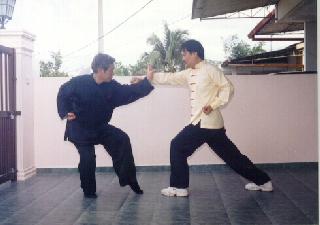
This is an excellent response against most hand attacks. As soon as your opponent attacks you, you strike the attacking hand and immediately follow up with two continuous punches. Obviously, if your opponent attacks with his right hand you would make the necessary modifications.
In a few more days I'll post the video for Sequence1 Application Part 2 - Opponent wards off.
Until then, have a great weekend.
Kindest regards
Marcus
Namo Amitabha Buddha Namo Amitabha Buddha Namo Amitabha Buddha
Question 2: Why is this first sequence important in Eagle Claw Kung Fu?
Maybe someone who knows more about Eagle Claw could explain why this first sequence is important, because I see no Eagle Claws in Sifu's solo demonstration and there are no (obvious) chin-na techniques, for which I know Eagle Claw Kung Fu is famous for.
I am in no way an Eagle Claw expert, beginner, or even student. However, the very first move, stepping to the poise pattern, utilizes both claws and chin-na. I'd say you could use that movement, with little or no alteration, to apply chin-na to a punch with either hand and a kick with either leg, and with any of those strikes being high, middle or low. So, I think that could be important.
I also noticed that the blocks are not a downward movement, in the same way that Single Tiger is not an outward movement. Single Tiger is leaning, and this block is a down and back sweeping movement. I would guess it would be the same type of movement one would need to blend with an opponents attack to apply the chin-na before they realized it.
During the block, both hands are doing this sweeping movement, so it would train both hands to intercept, blend, and control. And I think that could be key to many of the Eagle Claw applications.
Maybe someone who knows more about Eagle Claw could explain why this first sequence is important, because I see no Eagle Claws in Sifu's solo demonstration and there are no (obvious) chin-na techniques, for which I know Eagle Claw Kung Fu is famous for.
I'm not an Eagle Claw student, but one thought that came to mind was that all the patterns featured in Sequence 1 can be used as counters to qin-na techniques. For example, the transition to the poise pattern involves the hands moving out somewhat before coming back in, and if I remember correctly you can use this movement to release a grip on the wrist, much like Dragon and Tiger Appear can be used to release a grip on the wrist too. I also noticed that, in the transition to the poise pattern, the two fists clenched 'slowly', so maybe there's a grip there too.
I also made an interesting discovery when I tried this sequence out. I've been working on the rotation of the dan tian, and I noticed that in this sequence getting the rotation was much more difficult than in the Wahnam sequence 1, where you can get maximum rotation between the Single Tiger and the Black Tiger. So the sequence 1 for Eagle Claw might be a great way to train rotation of the dan tian/exploding force.
So the sequence 1 for Eagle Claw might be a great way to train rotation of the dan tian/exploding force.
I was going to add just another thought, and this ties in nicely. When I saw the video tonight for the first time, I thought to myself, "holy moly! that's not eagle claw, it's xing-yi!" Then I felt silly as I remembered the connection between the two.
But that could be another reason why it is important. It could be a glimpse into the higher art that was for the elite and not the grunts.
Thank you for your insightful and accurate posts. Very well done.
The next application video - Opponent Wards Off will be available as soon as Sifu Jordan updates the www.shaolinsummercamp.co.uk website. I'll post more later.
Thanks for reading.
Marcus
Namo Amitabha Buddha Namo Amitabha Buddha Namo Amitabha Buddha
As promised here is more information from Sifu's reply to my request for further information.
JoseFreitas, this is the information I have on Sifu Yeong Khuen Chi.
Sifu Yeong Khuen Chi is Sifu's Sidai (younger brother), even though he is older chronologically than Sifu. He is Uncle Righteousness' nephew. Besides learning from Uncle Righteousness, he also learned from a few masters at the Chin Woo Association in Penang in the 1950s and 60s.
Sifu also said:
I will post more information Sifu gave me regarding the Chin Woo Association in the next few days.
Kindest regards
Marcus
Namo Amitabha Buddha Namo Amitabha Buddha Namo Amitabha Buddha
Thanks Marcus, really, this is much appreciated, we've been trying to get info on our Sigung but it's hard. Pardon my ignorance, but is Sisak a "brother" or does it refer to another relationship?
The next application video - Opponent Wards Off will be available as soon as Sifu Jordan updates the www.shaolinsummercamp.co.uk website. I'll post more later.
As promised here are Sifu's comments on Applications 2 and 3. I've another 4 or 5 application videos for Combat Sequence 1. Then it's on to Combat Sequence 2. Only another 48 to go after that
The second and third combat application videos show the forte of Eagle Claw. Irrespective of whether the opponent wards off, moves away or counter-attacks – which virtually covers all aspects of his responses – you grip his wrist and strike him. Very few people would know how to defend against such formidable attacks. Yet, all our Shaolin and Taijiquan students should know the appropriate response. It is covered in the most elementary of our courses, the regional course where four combat sequences are taught.
Would any student like to share the appropriate response?
See you all again real soon with Application 4
Kindest regards
Marcus
Namo Amitabha Buddha Namo Amitabha Buddha Namo Amitabha Buddha
We process personal data about users of our site, through the use of cookies and other technologies, to deliver our services, personalize advertising, and to analyze site activity. We may share certain information about our users with our advertising and analytics partners. For additional details, refer to our Privacy Policy.
By clicking "I AGREE" below, you agree to our Privacy Policy and our personal data processing and cookie practices as described therein. You also acknowledge that this forum may be hosted outside your country and you consent to the collection, storage, and processing of your data in the country where this forum is hosted.
 Tweet
Tweet


Comment